On T hursday, September 17th, Virginia Beach will be the first speaker of the Seabrook Island Natural History Group’s Fall 2015 Evening Programs.
She is the author of “Rice & Ducks” which records the history of the South Carolina rice lands, a landscape that stretches all the way from the Pee Dee River to the Savannah. It is a story full of interesting and memorable characters, and unlikely allies. They include English Lords, Proprietors, southern plantation owners and slaves, northern industrialists, powerful U.S. Senators, daring scientists, media magnates, Trappist monks, and Wall Street financiers.
Refreshments – 7:00 PM Program – 7:30 PM Location – Lake House
All Seabrook Island residents and guests are welcome. There is a $5 donation for non SINHG members. Information about future programs and SINHG membership can be found at the SINHG web site, sinhg.org.
Gary Fansler
Category: Nature
Turtle News – Nest Inventory Monday at 4
The Turtle Patrol will inventory nests 65 and 66 Monday at 4 PM. Both nests are located on Zone 4 north of boardwalk 1 near the last “dog sign”.
Hope to see you there!
Terry Fansler
Public Officials to Address Offshore Drilling
U.S. Representative Mark Sanford and South Carolina State Senator Chip Campsen will speak at the “Not Worth the Risk” launch rally of the organization Don’t Drill Lowcountry. The event is being held on Tuesday, September 15th, from 6:30 to 8:30 PM at 32 Patriot’s Point Road in Mt. Pleasant. The meeting venue is the Yacht Club Room on the second floor of the Fish House restaurant. Free parking is available in the front and also in the Pavilion parking lot. Limited space is available, and organizers are asking for RSVP’s using this form.
The Town of Seabrook Island has passed a resolution in opposition to offshore drilling on the South Carolina coast.
—Submitted by Richard Wildermann
Don Smith’s Plant Files: Trumpet Vine
Many gardeners struggle with the idea of planting vines, envisioning uncontrolled jungle-like growth covering their home, shrubs, trees and other structures. However, if planted in the right place and routinely maintained, several native flowering vines can make valuable contributions to the color, texture and structure of the garden. This is particularly true of Trumpet Vine (campsis radicans).

Trumpet Vine, also known as Trumpet Creeper, is a deciduous, woody vine native to South Carolina and the rest of the southeast. It flowers on new growth with three inch, trumpet-like, bright orange to red blooms from summer into the fall. Pure yellow (‘Flava’), apricot (‘Apricot’) and pure red (‘Crimson’) cultivars are also available at many nurseries. The blooms develop into attractive bean-like seed pods, but the yellow-green leaves in the fall are not distinctive. Continue reading “Don Smith’s Plant Files: Trumpet Vine”
Turtle News – It’s all about Nest 63
Nest #63, located on Zone 3 south of walk #5, will be inventoried on Sunday at 8:30 AM. This nest was found by Joyce & Tom Pinckney & Marcia Papanek. Jen Gibson, the Doanes and Liz Devens moved it to it’s new location after the dune it had been on collapsed.
 Zone 3 had the most fun this morning. At nest #63 when we softened the sand, one baby poked his head out, then 11 more followed. So we had the pleasure of helping 12 babies safely to the water. A few vacationers had the thrill of seeing their first turtle babies.
-Submitted by Beautsie Zahrn
Turtle News – Nest 55 Inventory Results
Nest #55 was found by Sandy MacCoss and Elison Atkinson. Sandy found the eggs. It hatched in 61 days.
Eggs – 47
Shells – 27
Unhatched eggs – 20
Dead Hatchlings – 0
Live Hatchlings – 0
Total live – 27
Hatch success – 56.2 %
Emergence success – 56.2 %
-Submitted by Gary Falser
Visitor Captures Video of Dolphins Strand Feeding
Longtime Seabrook visitor Eileen DeCamp captured this impressive video of dolphins strand feeding a few days ago, showcasing some of the abundant wildlife with which we coexist on the Island. Thanks to Kristina Skalak and Kelly Butorac of the Club for sharing.
[Editor’s Note: Everyone loves dolphins, but most people do not realize that NOAA Fisheries officials urge people to move at least 50 yards away from dolphins when they are strand feeding. Use binoculars or zoom lenses on cameras to get good views. Be aware that feeding, attempting to feed, or harassing wild dolphins while feeding is both harmful and illegal. The same goes for touching or swimming with them. Civil penalties and criminal penalties are posted. For more information, click here. Bottom line: Please keep your distance, let them do their thing, and help others become aware of our need to respect these wonderful creatures.]
Shark Facts and Safety Tips
 According to the International Shark Attack File, ten individuals have been attacked by sharks so far this year along the coasts of North and South Carolina. Six is the average annual number of shark attacks along this two-state coastline.
To reduce the risk of encountering a shark while in the water you should do the following:
• Always swim with a group. Sharks are more likely to attack an individual swimmer.
• Do not wander too far from shore. Doing so increases your vulnerability and places you further from help.
• Avoid going into the water during darkness or twilight hours. This is when sharks are most active and can bring their sensory advantage to bear.
• Do not enter the water if bleeding from an open wound. Use caution if menstruating. A shark’s olfactory ability (sense of smell) is acute. The presence of even small traces of blood from recent minor cuts or bruises may precipitate a shark attack.
• Do not wear shiny jewelry (e.g., bracelet or watch) because the reflected light resembles the sheen of fish scales.
• Avoid waters being used by sport fishermen, particularly if they are chumming or baiting the water to attract fish.
• Avoid waters where there are indications of feeding activity such as diving seabirds.
• Do not assume the presence of dolphins indicates the absence of sharks. Both dolphins and sharks feed on the same prey.
• Exercise caution in cloudy water and avoid uneven tanning and bright colored clothing. Sharks have excellent vision, but lack visual acuity. They can easily mistake a human for natural prey.
• Refrain from excess splashing and do not allow pets into the water because of their erratic movements. Sharks are attracted to motion. They also possess the ability to sense the bioelectric field generated by an animal’s nerves and muscles.
• Exercise caution when swimming in areas between the beach and offshore sandbars or near steep drop-offs. These are prime shark feeding grounds.
What to do if you are approached or attacked by a shark: Continue reading “Shark Facts and Safety Tips”
New! Introducing TIDECASTING: Audio Interview with Steve Traynum of Coastal Science and Engineering

Today, TIDELINES introduces a new podcast series we’re calling “Tidecasting.”
Tidelines writers and editors are constantly casting our nets for topics of special interest to our readers and followers. Sometimes the best way to present this newly found content is in the form of in-depth, compelling audio interviews we call Tidecasts.
Our first Tidecast is a June 17th interview with Steve Traynum of Coastal Science and Engineering. Mr. Traynum was the project manager for the Cap’n Sam’s Relocation Project between Seabrook Island and Kiawah Island, which is now concluding. In this 20-minute interview with Tidelines writer Barbara Burgess, Mr. Traynum provides fascinating behind-the-scenes details about the project and how it was accomplished. The podcast was produced by Shawna Jarrett, SIPOA Communications Administrator.
So turn up your audio speakers and click the start arrow > on the bar above. You can pause the recording at any time by clicking in the same place.
Enjoy the Tidecast, leave a comment, and look for more Tidecasting posts in the future.
—Tidelines Editors
Click here for downloadable version
(Right-click or long-hold on player, choose download to save to your computer or other device)
CAP’N SAMS RELOCATION UPDATE 6/12/2015
Thursday evening during the low tide cycle, R.E. Goodson began the inlet closure sequence. Coastal Science and Engineering and the Goodson crew worked non-stop until 4:45am to install the initial berm. They were back at work at 7:00am today and will be on site for the next few days to expand the berm using the remainder of the stockpiled sand. The closure will be completed in accordance with the final engineering specifications and dimensions.
The aerial photos and video taken at 8:00 am today provide an illustration of the extent of the work accomplished overnight!


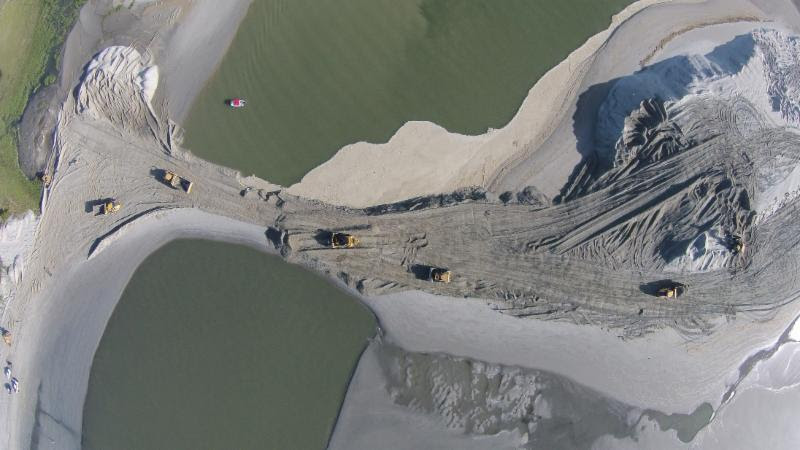
Cap’n Sams Cut– Today’s Photos 6/12/2015– Patricia Schaefer


I think this one is looking for his nest.
Truck for sale!
Thanks to these guys for all their hard work!
Patricia Schaefer
Video of Truck Recovery in Cap’n Sams 6/10/2015
This video shows the recovery of the truck that was lost in closing of the cut last week.
Video by Hal Copple