Lowcountry HogFest – September 4-5th

The Low Country HogFest will be held September 4th and 5th at 4704 Dorchester Road (behind Harley Davidson).

hog-fest-flyer-20151Low Country Hog Fest is a community event complete with a sanctioned Kansas City Society BBQ contest, live music, kid’s zone, custom car show, tattoo contest, beard & moustache contest, wing eating contest, and corn-hole tournament to benefit MUSC Children’s Hospital. One of the many ways to get involved is through the Adopt –A-Hog program.  Concrete hogs were adopted by businesses, organizations, and individuals and decorated earlier in the summer.  Come out and see the hogs on display, taste BBQ, drink beer, listen to music – – all to benefit MUSC Children’s Hospital  for more information, go to www.lowcountryhogfest.com

(Photo credit:  Post & Courner Sep3, 2015)

-Submitted by Tidelines Editor


SINHG Kicks Off Fall Evening Programs September 17th

On Thursday, September 17th the Seabrook Island Natural History Group’s first evening program for the Fall 2015 series is Virginia Beach. Her topic is “Rice and Ducks, the Surprising Convergence that Saved the Carolina Lowcountry”.

Virginia is a graduate of the University of Virginia and a former Peace Corps volunteer in East Africa. She writes for numerous publications on the subjects of conservation and natural history and is the author of Medway, a history of a South Carolina plantation. In addition, she has also served on the staffs of The Nature Conservancy, the Lowcountry Open Land Trust and the South Carolina Sea Grant Consortium.

She is also the author of “Rice & Ducks” which records the history of the South Carolina rice lands, a landscape that stretches all the way from the Pee Dee River to Savannah. It is a story full of interesting and memorable characters, and unlikely allies. They include English Lords, Proprietors, southern plantation owners and slaves, northern industrialists, powerful U.S. Senators, daring scientists, media magnates, Trappist monks, and Wall Street financiers.

Please join us at the Lake House to learn more about this fascinating aspect of the history of the low country. Refreshments will be served at 7 PM and the program will begin at 7:30. All Seabrook Island residents and guests are welcome. There is a $5 donation for non SINHG members. Information about future programs and SINHG membership can be found at the SINHG web site, sinhg.org

Submitted by Gary Fansler

Inline image 1

List of Emergency Preparedness Links

[Ed. note: The following showed up in our inbox courtesy of a public service organization in North Carolina. Although the content in each link may not be 100% relevant for our readers, there is sufficient content regarding emergency preparedness to be of good value, especially at this time of year.]

With the sudden downpours to which we’re prone at this time of year, and in preparation for storms in the next few months, this is a great time to become educated and prepared if a flood disaster should strike.

FloodSmart Community Resources
https://www.floodsmart.gov/floodsmart/pages/partner/partner_index.jsp

Home Safety Checklist
http://www.mortgagecalculator.org/helpful-advice/home-safety-checklist.php

Red Cross Disaster Safety Checklist
http://www.redcross.org/prepare/disaster-safety-library

How to Protect Your Home From Flood Damage
https://www.redfin.com/blog/2015/03/how-to-protect-your-home-from-flood-damage.html

Emergency Planning – Protect Your Pet
http://www.paw-rescue.org/PAW/PETTIPS/DogTip_EmergencyPlanning.php

How to Avoid Flood Damaged Cars
http://www.carfax.com/guides/buying-used/things-to-avoid/flood-damage

STEM Challenge for Kids – Building Flood Resistant Homes
http://practicalaction.org/beattheflood

I hope these will prove to be useful to you and your audience.

Happy learning!

—Submitted by Jasmine Dyoco
information@educatorlabs.org
http://educatorlabs.org/

Visitor Captures Video of Dolphins Strand Feeding

Longtime Seabrook visitor Eileen DeCamp captured this impressive video of dolphins strand feeding a few days ago, showcasing some of the abundant wildlife with which we coexist on the Island. Thanks to Kristina Skalak and Kelly Butorac of the Club for sharing.

[Editor’s Note: Everyone loves dolphins, but most people do not realize that NOAA Fisheries officials urge people to move at least 50 yards away from dolphins when they are strand feeding. Use binoculars or zoom lenses on cameras to get good views. Be aware that feeding, attempting to feed, or harassing wild dolphins while feeding is both harmful and illegal. The same goes for touching or swimming with them. Civil penalties and criminal penalties are posted. For more information, click here. Bottom line: Please keep your distance, let them do their thing, and help others become aware of our need to respect these wonderful creatures.]

Guest Columnist Dr. Roy Sessions, M.D.-The Allure of Alternative Cancer Remedies

This is part of a series of columns on the doctor/cancer patient relationship by Seabrook resident Dr. Roy Sessions, MD, and Fellow of the American Council of Surgeons.RoySessions

In a recent series of essays, I focused on the interpersonal relationship between physician and patient – especially, but not exclusively cancer-related. Perhaps I’ll come back to that at a future date – it’s a bottomless trove of issues – and at that time, I’ll review what we have previously discussed, so as to make it easy to pick up where we left off. In a search for literary diversity, today I’ll change gears and talk about certain influences on the attitudes and receptiveness of patients undergoing the cancer experience; there are a number of potential extraneous matters available, but for starters, I ask the reader to consider the seductive appeal of alternative medicine and methods that have not been vetted by the appropriate scientific community. Continue reading “Guest Columnist Dr. Roy Sessions, M.D.-The Allure of Alternative Cancer Remedies”

Shark Facts and Safety Tips

Shark-Clipart-1According to the International Shark Attack File, ten individuals have been attacked by sharks so far this year along the coasts of North and South Carolina.  Six is the average annual number of shark attacks along this two-state coastline.

To reduce the risk of encountering a shark while in the water you should do the following:

• Always swim with a group.  Sharks are more likely to attack an individual swimmer.
• Do not wander too far from shore.  Doing so increases your vulnerability and places you further from help.
• Avoid going into the water during darkness or twilight hours.  This is when sharks are most active and can bring their sensory advantage to bear.
• Do not enter the water if bleeding from an open wound.  Use caution if menstruating.  A shark’s olfactory ability (sense of smell) is acute.  The presence of even small traces of blood from recent minor cuts or bruises may precipitate a shark attack.
• Do not wear shiny jewelry (e.g., bracelet or watch) because the reflected light resembles the sheen of fish scales.
• Avoid waters being used by sport fishermen, particularly if they are chumming or baiting the water to attract fish.
• Avoid waters where there are indications of feeding activity such as diving seabirds.
• Do not assume the presence of dolphins indicates the absence of sharks.  Both dolphins and sharks feed on the same prey.
• Exercise caution in cloudy water and avoid uneven tanning and bright colored clothing.  Sharks have excellent vision, but lack visual acuity.  They can easily mistake a human for natural prey.
• Refrain from excess splashing and do not allow pets into the water because of their erratic movements.  Sharks are attracted to motion.  They also possess the ability to sense the bioelectric field generated by an animal’s nerves and muscles.
• Exercise caution when swimming in areas between the beach and offshore sandbars or near steep drop-offs.  These are prime shark feeding grounds.

What to do if you are approached or attacked by a shark: Continue reading “Shark Facts and Safety Tips”

New! Introducing TIDECASTING: Audio Interview with Steve Traynum of Coastal Science and Engineering

tidecasting


Today, TIDELINES introduces a new podcast series we’re calling “Tidecasting.”

Tidelines writers and editors are constantly casting our nets for topics of special interest to our readers and followers. Sometimes the best way to present this newly found content is in the form of in-depth, compelling audio interviews we call Tidecasts.

Our first Tidecast is a June 17th interview with Steve Traynum of Coastal Science and Engineering. Mr. Traynum was the project manager for the Cap’n Sam’s Relocation Project between Seabrook Island and Kiawah Island, which is now concluding. In this 20-minute interview with Tidelines writer Barbara Burgess, Mr. Traynum provides fascinating behind-the-scenes details about the project and how it was accomplished. The podcast was produced by Shawna Jarrett, SIPOA Communications Administrator.

So turn up your audio speakers and click the start arrow > on the bar above. You can pause the recording at any time by clicking in the same place.

Enjoy the Tidecast, leave a comment, and look for more Tidecasting posts in the future.

—Tidelines Editors

Click here for downloadable version
(Right-click or long-hold on player, choose download to save to your computer or other device)

Cap’n Sams Relocation Project 6/11/2015

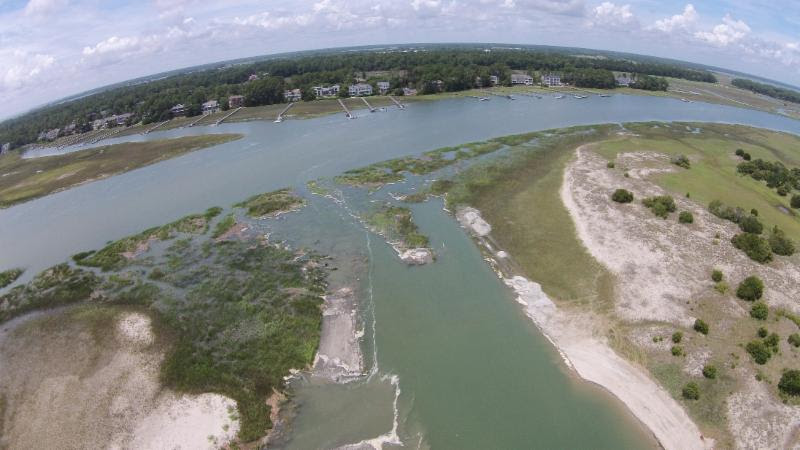
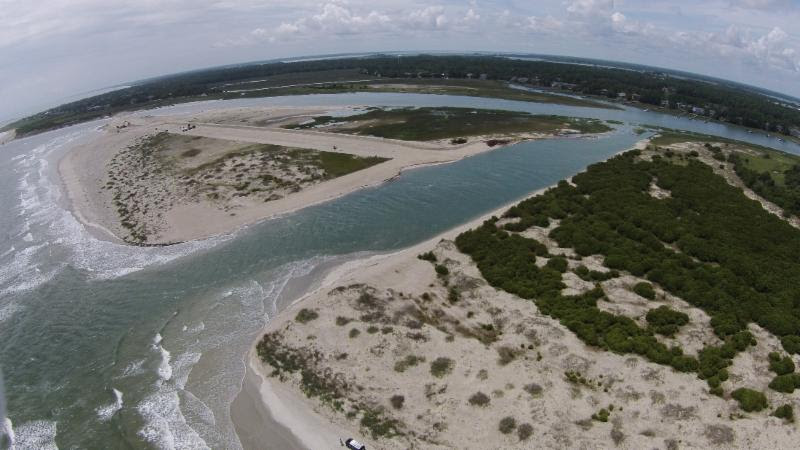
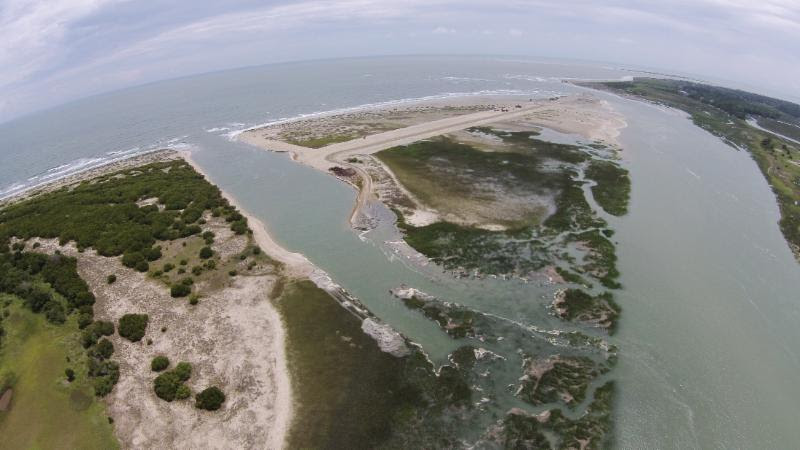
On Wednesday, following the dump truck and bulldozer removal, R.E. Goodson made the final opening in the channel that was opened last week. The attached aerial photos show the completed channel.

R.E. Goodson has worked throughout the day to build up the sand stockpiles. After lengthy discussions late this afternoon with Coastal Science and Engineering and R.E. Goodson, SIPOA has been advised that the optimal time to do the closure is this evening during the low tide cycle. The closure attempt will take place during the evening hours and should be completed before sunrise.


Heather Paton
SIPOA Executive Director

Seabrook Island Property Owners Association
1202 Landfall Way
Johns Island, SC 29455

CAP’N SAMS RELOCATION UPDATE 6/12/2015

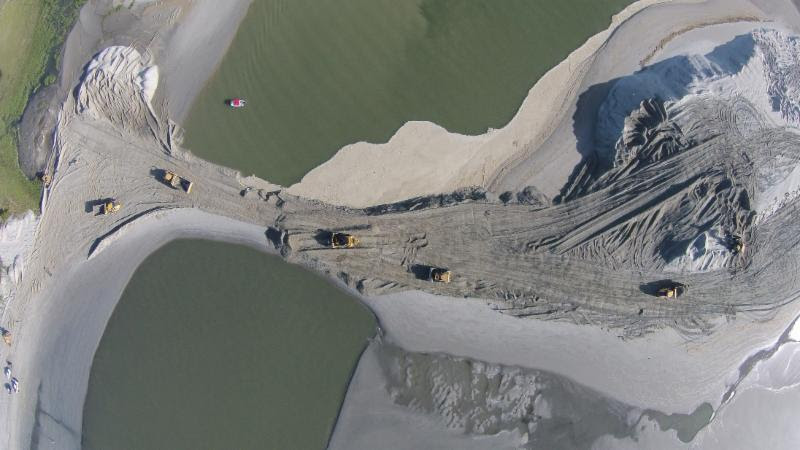
Thursday evening during the low tide cycle, R.E. Goodson began the inlet closure sequence.  Coastal Science and Engineering and the Goodson crew worked non-stop until 4:45am to install the initial berm.  They were back at work at 7:00am today and will be on site for the next few days to expand the berm using the remainder of the stockpiled sand.  The closure will be completed in accordance with the final engineering specifications and dimensions.

The aerial photos and video taken at 8:00 am today provide an illustration of the extent of the work accomplished overnight!

CLICK HERE FOR VIDEO

Heather Paton,
SIPOA Executive Director